PvP & Contracts
Every player can engage in battle with another, but the PvP (player versus player) system follows a set of rules and mechanics that should be understood in advance. Let’s explore the key aspects of player battles.
Core Concepts of PvP
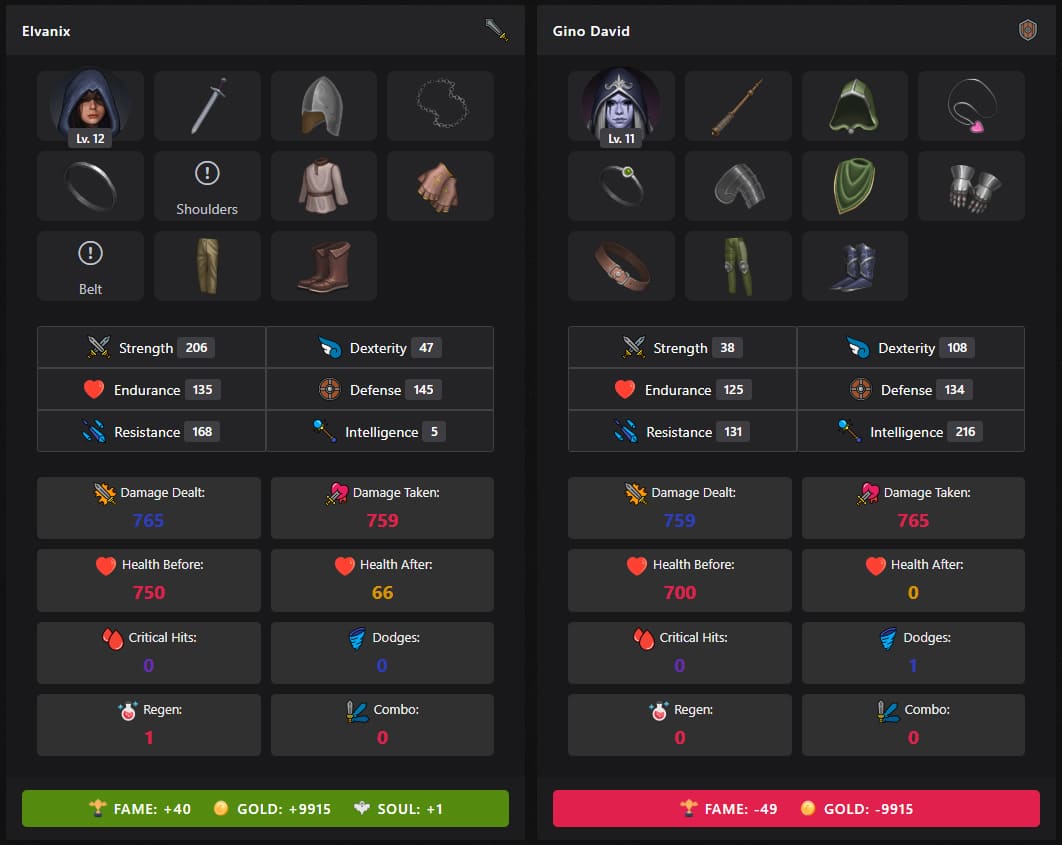
- Fame - a value that rises or falls based on the outcomes of PvP encounters. It's not just prestige, but a currency of respect in the world of Areldor.
- Statistics - the number of victories, kills, and looted gold. These metrics reflect a hero’s combat experience.
- Souls - represent the number of defeated opponents. They can be used to unlock rare active skills and enhance the hero’s power.
Level Ranges
PvP is only allowed between players within a certain level range. There are two scenarios:
- Standard Attack: if the target’s level is no more than 15 below the attacker’s. Example: A level 80 player can attack players from level 65 and up. However, if the attacker’s level exceeds the target’s by more than 10, they will lose part of their fame, regardless of the battle's outcome.
- Risky Attack: if the attacker is weaker than the target. Example: A level 20 player can attack a level 90 player. If victorious — and the level difference is more than 5 — the attacker earns additional fame for bravery and skill.
Defensive Barrier
After being attacked, a player gains a protective shield for 1 hour, preventing further attacks.
Attack Frequency Limit
After a battle with a specific player, you can’t attack them again for 5 hours.
Daily Attack Limit
- Each player has a maximum of 30 points of PvP energy.
- Each attack consumes 1 point.
- Energy regenerates at a rate of 1 point every 30 minutes.
Combat Mechanics
Player battles in our world take place in a turn-based mode, where as a general rule, the right of the first strike belongs to the attacking side. The total damage heroes deal to each other is calculated based on their key attributes, such as strength or intelligence, while each specific skill has its own unique impact on the duel's outcome. To achieve maximum efficiency, it is crucial for players to always use the best equipment to boost character stats and remember to set active skills in the settings. Keep in mind that any selected active skill triggers in combat immediately before a regular attack is performed.
Despite the aggressor's advantage, the attacker should always be prepared, as the defending player has a certain chance to strike first. In the event of such an initiative steal, the attacker completely skips their first turn, including the possibility of using any active skill. Additionally, players must carefully monitor their health status before a clash begins. If your health is zero at the start of the battle, the system will automatically record a defeat; therefore, timely healing is a mandatory requirement for participating in PvP.
Beyond the rules mentioned above, the combat system includes many other mechanics that are not detailed here. Some of these will be added and refined as the project develops, so players will have to experience all the intricacies and nuances of battle firsthand during gameplay.
Opponent Search System — Contracts
A player can manually find targets and attack them via profile, if they’re in the same location. Alternatively, use the “Contracts” system.
Search Settings
Geography:
- Local — targets in your current location.
- Global — targets across the entire world of Areldor.
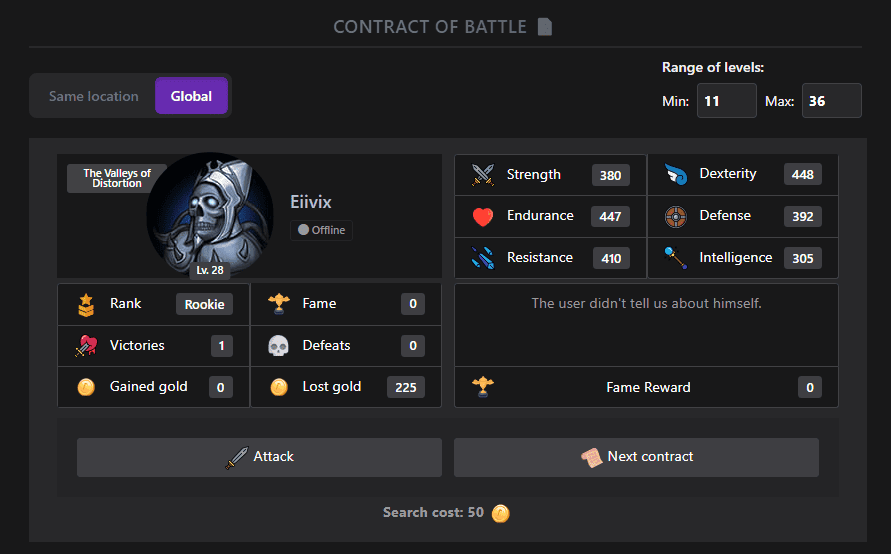
Level Range: set minimum and maximum target levels to match your power and ambition.
Contract System Mechanics: after pressing [Find Contract], the system presents a suitable opponent with: name and avatar, level, core attributes (Strength, Agility, Vitality, etc.), current fame and statistics. You can attack a player or search for another contract.
The bottom of the interface shows the Top-10 most famous players — the legends of Areldor. You can also attack them if you dare.
- Want fame? Hunt the strong and renowned.
- Prefer stability? Seek opponents equal to or weaker than you.
- But beware — some players set “bait”: weak-looking profiles hiding deadly builds.